
Friendship, freedom and ideas: remembering the women of the Lyceum Club
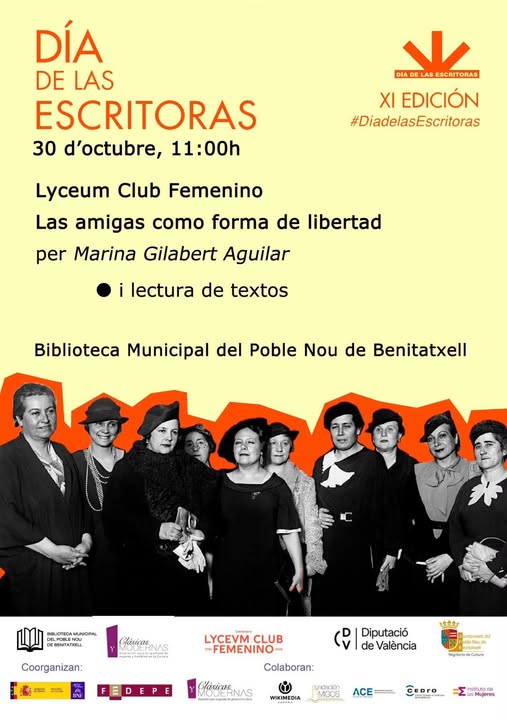
Marion Oprel reflects on Marina Gilabert Aguilar’s talk in Benitachell about the pioneering women of the Lyceum Club and what their commitment to friendship, freedom and equality means a century later.
"Great minds discuss ideas; average minds discuss events; small minds discuss people" is a quote attributed to Eleanor Roosevelt.
The great mind that familiarised us with all three, in her presentation of the ‘Lyceum Club Feminino’ in the Benitachell library yesterday morning, is called Marina Gilabert Aguilar.
Marina represents the national organisation ‘Clásicas y Modernas’ of feminist writers and scientists, and along with counselor Isabel Garrido, librarian Lola Bolufer and retired teacher and entrepreneur Pepa Gilabert, she forms the beating heart of cultural life in Benitachell and beyond, stimulating regional and even national initiatives such as ‘Libraries and Equality’, and ‘Living memory’.
When I arrived at the top floor of the library towards 11 o’clock, a flock of women and two men were enjoying coffee and cake. I was wondering whether I was arriving late or maybe halfway through the presentation, but no, I was told that the reading club had just held its bi-monthly session.
They had discussed a novel in Valenciano on the Covid years in Ondara, written by Jovi Lovano-Seser. The reading club alternates novels in Valenciano and in Castellano. Anyone is welcome to join.
I received a very kind welcome, which warmed my ‘giri’ (foreigner’s) heart. These villagers and city dwellers (some live both here and in Valencia) are happy to learn more about their own history and culture, and most willing to share their insights with those of us coming from afar.
The Lyceum Club Feminino was initiated exactly one hundred years ago, and the commemoration of its founding coincides with the ‘Día de las Escritoras’ (Women Writers’ Day), celebrated annually on the Monday closest to the 15th of October, the date on which Theresa of Ávila, patron saint of female writers, passed away.
Clásicas y Modernas, by the way, was the driving force behind the launch of this day by the Spanish National Library.
So in 1926 the first meeting of the Lyceum Club Feminino was held. Ten years later, well-educated republican-minded women would have to flee from the bombing of Madrid to the more liberal Valencia area. In Madrid, female teachers and speakers and noblewomen were cancelled and prosecuted at the time. Some forms of education were abolished. Nuns applied physical castigations to girls that dared to speak their mind.
On the 4th of November 1926, 115 women came together in the house with the seven chimneys (currently the seat of the Ministry of Culture), and in 1930 Barcelona followed suit in setting up a local chapter.
There were medical doctors, teachers, architects and various other professionals. Anything except judges. Only men were allowed in that professional category.
Core values of these activist ladies were friendship, freedom, and the longing to express and exchange ideas, and to write about them.
Women had been officially admitted to universities since 1910. They received a space, and developed a voice. The more well-off members financed facilities such as a school for the visually impaired, and child care so that other women could work, and they paid for their own and other’s international travels to represent the Lyceum Club Feminino on various continents.
Maria de Maeztu, one of the founders and a philosopher and literary scientist, spoke several languages and went on a lecture tour of the United States, Great Britain, Argentina and Cuba, launching an appeal for equality, for women’s rights in general, and more specifically the right to vote, to divorce and to have an abortion.
After the gloom of the First World War and the loss of the Spanish colonies, there was hope in the air. Hope for freedom of thought, financial independence and freedom to make one’s own life choices.
Fostering ideas meant developing aspirations. Friendship led to greater freedom. Helping each other to develop talents led to stronger bonds and realisations.
Ortega y Gasset and Federico Garcia Lorca were among the prominent thinkers that were honoured to speak at the Lyceum Club’s meetings and conferences.
Some 700 members were proud to form part of the movement, until the horrors of the Civil War brought an end to this idealistic and innovative community.
Members were incarcerated or were forced to flee abroad.
In 1936, ten years after the promising start, the curtain fell. The association was forbidden and the modern female voice was silenced.
I would like to thank Marina for her talk yesterday, and for allowing those present to reflect on the value of independent thinking, coupled with open exchanges and the development of new initiatives. A century ago and here and now in the Marina Alta.
On my way out I picked up a photo book by the El País newspaper, entitled ‘La transición’, on the era after the death of the dictator. Leafing through it I saw the overrepresentation of the male gender in shaping a democracy.
Where were the women?
And how much do I really know about the suppression, the terror, the division, the horrors brought about by power-hungry men in this country’s history?
And are we aware of the extent of similar tendencies in the current political landscape?
How can we as contemporary women promote values of justice, diversity and equality?
There is still a lot to learn, and I am looking forward to Marina’s next presentation.
Don’t hesitate to come along next time!
Marion Oprel, 31 October 2026
Would you like to reply? You can do so in our Facebook group, where Facebook will ask you to join the group first, or write to us at president@euwmarinaalta.org.