
Benitachell Literary Festival
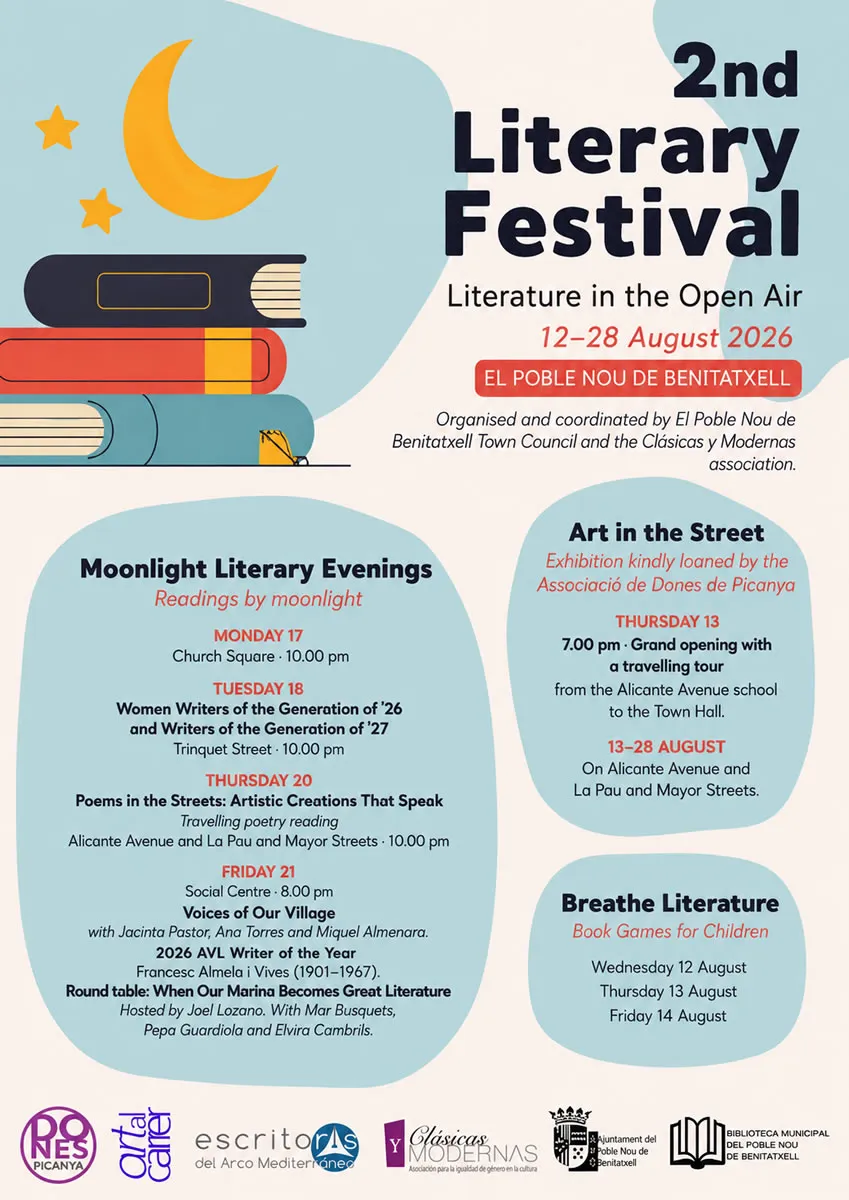
Culture returns to the streets of Benitachell! From 12 to 28 August, the second “Literatura a la Fresca” Literary Festival brings the village squares to life with creativity, spoken-word tradition and art, all played out beneath the summer sky.
- When
- 12 to 18 August 2026
- Where
- Various venues, Benitachell
- Price
- Free
- Language
- This event is in English.
- Organised by
- The European Union of Women Marina Alta, Clasicas y Modernas, Benitachell Town Hall
Please check with the venue that it suits your access needs.
Among the main evening events, Tuesday 18 August is dedicated to “Women Writers of the Generation of ’26 and Male Writers of the Generation of ’27.”
The EUWMA is delighted to participate in this event. Emma, Marion, Margaret, Mihaela and Kathleen will recite works from the following writers under the stars on a summer evening in English, Dutch and Spanish. We do hope you will join us for good company, an unforgettable summer evening of thought-provoking readings, with some traditional snacks and moscatel served afterwards.
Tuesday 18 August 22:00
Carrer Trinquet, Benitachell…
Enter via Avenida de Alicante, turn left onto Avenida de Valencia and continue to the car park next to the cemetery. Alternatively, you can come up from the golf course via the old road and park in the cemetery car park. The venue is very close by.
Here is a little about the works that will be recited, to inspire you:
Carry van Bruggen (1881-1932)
Carry van Bruggen was one of the most lucid intellectuals of the Netherlands, known for her sharp cultural criticism and her exploration of the human psyche.
Her masterpiece, the modernist novel Eva (1927), stands as an intense novel of consciousness and interior monologue.
The book traces the evolution of a young Jewish woman as she seeks to build an autonomous identity in the face of rigid social norms.
It was pioneering in addressing the tension between bodily desire, sexuality and intellectual ambition.
The protagonist rejects the moral and gender conventions of her time.
The novel also examines the conflict between the individual and the collective, or between the individual and religion.
It uses avant-garde narrative techniques to capture the flow of the character’s thoughts.
Today, Eva is still regarded as a landmark work, remarkably modern in its universality.
Emmeline Pankhurst, 1908
Emmeline was a famous British suffragette. Rejecting the more respectable methods used by other women fighting for the right to vote, she sought greater visibility for the cause. Yet in defying the gender norms of her time, she was setting aside deeply entrenched nineteenth-century ideas, above all the belief that women were delicate, demure creatures whose only proper place was the home. She was courteous, yet forceful in her struggle.
Margaret, a descendent of Emmaline Pankhurst, will read some paragraphs from her lengthy “Speech from the Dock” delivered at Bow Street Court, when she and other women stood trial for disturbing the public order. They were found guilty and imprisoned.
Miles Franklin, 1901
My Brilliant Career was written by the Australian author Miles Franklin while she was still a teenager, and was published in 1901. Set against the harshness of rural Australia, this spirited, semi-autobiographical novel tells the story of Sybylla Melvyn, a young woman of extraordinary intelligence who struggles against poverty and the narrow expectations imposed on women. In this passage, Sybylla’s youthful ambition collides with the painful realities of gender inequality, gruelling work and rural life; and yet her voice remains bold, clear-eyed and defiantly alive.
Rose Macaulay (1881-1958)
Rose was a prominent British writer of the twentieth century, celebrated for her irony, her satirical wit and her commitment to the suffrage cause. Political and social activism was central to her life, and she argued firmly for women’s votes and women’s rights at a time of profound change.
Through both her life and her work, Macaulay actively pursued an alternative to the traditional role assigned to women. She rejected the domestic roles imposed by a patriarchal society, choosing instead economic independence, intellectual singlehood and a prolific literary career.
Her book A Casual Commentary (1925) reflects the society of her time, gathering short essays full of humour and scepticism.
The full literary programme includes evening reading sessions in the village squares, children’s activities and the moving travelling exhibition “Art al Carrer” (Art in the Streets). Featuring 101 works of feminist art loaned by the Associació de Dones de Picanya (Picanya Women’s Association), the exhibition will adorn balconies throughout the village. It includes canvases recovered from the mud following the devastating floods of 2024, serving as symbols of resilience and overcoming adversity.
To round off the festival’s main week, Friday 21 August will feature a special programme in three parts: the local showcase “Voices of Our Village”; a tribute to Francesc Almela i Vives, named the Valencian Academy of the Language’s Writer of the Year for 2026; and the round-table discussion “When Our Marina Becomes Great Literature,” featuring writers Mar Busquets, Pepa Guardiola and Elvira Cambrils.