
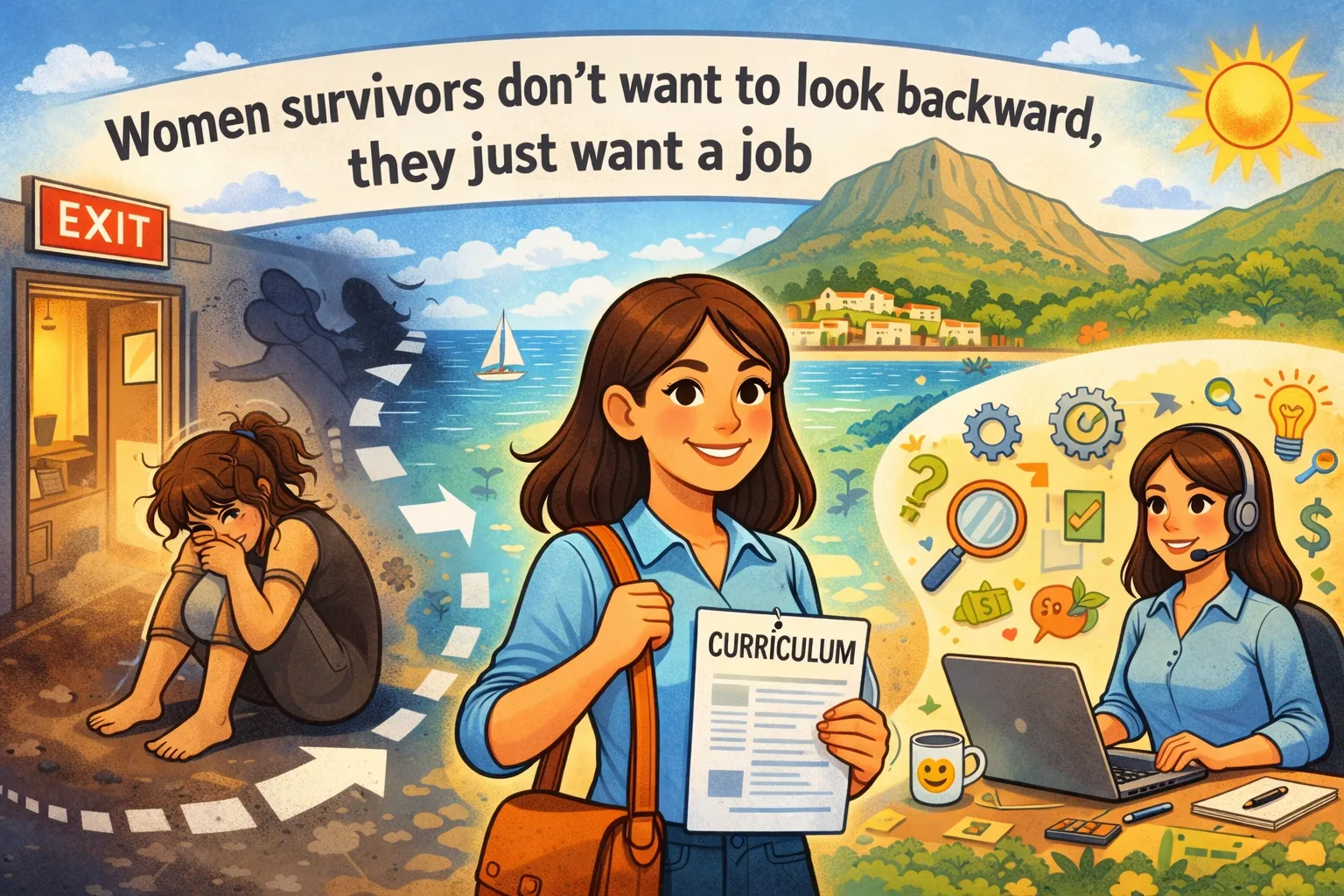
Women survivors don’t want to look backward, they just want a job
Marina Alta Regional Coordination Roundtable: Socio‑occupational Integration Project for Women Affected by Gender‑Based Violence
On Friday I attended the second regional coordination roundtable organised by the Marina Alta Equality Network in Denia. The meeting brought together around thirty professionals and associations working in equality, social services and employment support across the region.
I found it fascinating. A room of 30 bright and dedicated women attempting to work out an entire information architecture, to best assist women in situations of domestic violence in their journey through the jobseeking process. I am sure you could only imagine the bottlenecks and bureaucracy that social workers, counsellors and others come up against in gaining access to information.
Very early on in the discussion, the human element came out… These women who are looking for a job just want a job. They are looking for normalcy. The system makes them go all through ‘again’ (and sometimes again and again with each different person or department they talk to) their whole past situation of dv, was a denouncement made?… dates.. events… circumstances… it must be exhausting. They just want to move on with their life plan.
Patricia López, the project lead for the regional initiative to promote the employment and social integration of women who are victims of gender-based violence, used the big whiteboard in the room and filled it up with postit notes, valuable contributions from everyone present, including me (us). It was a great mind map.
The focus is a new collaborative project to improve the pathway into employment for women who are victims of gender-based violence. The idea is to create a more joined-up and humane process so that women do not have to keep repeating their stories to different services and can move more easily towards training, work opportunities and a sense of normal life again.
There was a strong emphasis on better coordination between organisations, clearer information systems and practical support both for the women and for local businesses willing to offer employment opportunities.
I found the session very interesting and positive. I would like to continue following how this develops and, where possible, offer our support in a realistic and helpful way.
Further details about the event and the project:
The roundtable took place on Friday 13 March at the Centro de Dones in Dénia and brought together approximately thirty participants representing municipal equality departments, social services, employment and training providers, women’s associations, business organisations and other regional stakeholders. The meeting formed part of an ongoing regional initiative aimed at strengthening cooperation across institutions and improving practical pathways into employment for women transitioning out of specialised support services.
Strategic objective of the regional project
The project responds to an identified structural gap between the conclusion of gender‑violence support interventions and women’s effective entry into the labour market. Its central aim is to establish a structured and sustainable regional pathway that promotes autonomy, economic independence and long‑term social recovery. The initiative is grounded in regional employability research and business‑sector outreach, highlighting both the existence of unfilled job vacancies and the need for stronger coordination between public administrations, employers and support organisations.
Conceptual model discussed
The employment‑integration pathway was presented as a coordinated process including detection and reception, personalised employability assessment, technical and transversal skills training, active job intermediation, emotional and logistical support, support to participating companies and structured follow‑up after labour‑market entry. The approach is aligned with Integrated Integration Pathways methodologies promoted within European Social Fund programmes, emphasising holistic and personalised interventions for individuals facing multiple barriers to employment.
Key operational insights
Participants highlighted the fragmentation of information systems and the administrative and emotional burden placed on women who must repeatedly recount traumatic experiences when navigating multiple services. The discussion emphasised the importance of restoring normality and supporting individual life‑planning. In this context, the development of an integrated regional information architecture was identified as a key enabling factor for effective intervention.
Stakeholder ecosystem
The initiative involves a wide regional network including municipal equality and social‑services departments, regional government bodies, employment and training providers, business associations, third‑sector organisations and higher‑education institutions. This multi‑stakeholder approach is intended to reduce duplication, improve coordination and ensure that gaps in support pathways are systematically addressed.
Governance and institutional context
The project is coordinated by the Marina Alta Regional Equality Network, a public inter‑municipal cooperation platform established to align equality policies and gender‑violence responses across the comarca. The network operates as a collaborative governance mechanism within the public‑administration ecosystem rather than as an independent NGO, drawing primarily on municipal and regional public funding frameworks.
January 2026 press release
Here is (a translation of) a January 2026 press article from Lamarinaalta.com that explains the project…
The Marina Alta Equality Network charts the path towards employment integration for women who are victims of gender-based violence
10 January 2026, Itsaso Aurrekoetxea Jover
The Marina Alta Equality Network brought together a range of regional stakeholders on Friday 9 January 2026 at the CREAMA headquarters in Dénia, all involved in equality and social services, in order to advance the Employment and Social Integration Project for Women Affected by Gender-Based Violence in the Marina Alta. The initiative seeks to create a coordinated and sustainable regional model capable of overcoming the barriers that hinder the employability of this group.
Image: Presentation of the “Employment and Social Integration Project for Women Affected by Gender-Based Violence in the Marina Alta” by the regional Equality Network
The employment integration project emerged following the technical committee’s identification of a critical “gap” between women leaving support services for victims of gender-based violence and their effective entry into the labour market. The need for a structured pathway was identified to facilitate and safeguard victims’ right to full social and employment integration. For this reason, the project is conceived as a key element in promoting women’s autonomy, economic independence and the prevention of future situations of violence.
Key regional stakeholders and a clear shortcoming: the business sector
Javier Scotto, Councillor for Equality in Dénia, and Aina González Naya, Equality Officer at Xàbia Town Council, opened the information session attended by technical staff, equality practitioners, councillors, social workers and associations from across the region, including Matria, the Dénia Women’s Association and representatives of the ALBA programme. Following brief introductions by participants to gauge the scope of the meeting, Scotto highlighted the absence of “one of the essential pillars of the process: the business sector”.
Image: Javier Scotto, Aina González and Patricia López, speakers at the Marina Alta Equality Network information session
In this regard, the Equality Councillor stated that the political leadership would assume responsibility for establishing direct contact with the sector and that a specific call would be issued to the main regional business associations, such as Jovempa and AEHTMA.
For her part, the Equality Officer from Xàbia explained that the Marina Alta Equality Network, established in 2021 under the umbrella of the Marina Alta Social Services Consortium (MASSMA), will now become part of the Marina Alta Regional Consortium (MACMA), following the approval of its regulations at the plenary session held in December 2025.
Business outreach study and regional employability assessment
After setting the context for the meeting, Patricia López, chartered health and forensic psychologist, a specialist in gender-based violence and one of the project’s technical leads, presented progress on the regional initiative.
López explained that the project follows a business outreach study and a regional employability assessment conducted by ESOC Consultancy. According to the specialist, the study is essential because “employment integration is key to the autonomy and recovery of women who have experienced gender-based violence”. However, such integration faces multiple structural, cultural and institutional obstacles.
Image: Patricia López, psychologist and technical lead of the Employment and Social Integration Project
The central aim of the study was to analyse the reality of the regional productive fabric in order to determine companies’ needs and their willingness to hire women who are victims of gender-based violence.
Unfilled vacancies and the role of incentives
The study revealed that while 53% of companies reported having vacancies, half indicated difficulties in filling them, confirming the existence of genuine unmet labour demand.
The research also explored what motivates companies to recruit from this group. It concluded that although almost half (48.7%) would do so out of social awareness, financial incentives (subsidies and support schemes) are the decisive factor for the majority (52.6%).
Perhaps the most significant finding was that the obstacles are not limited to the women themselves but operate at multiple levels. Among women, the study identified a lack of specific training, the digital divide, language barriers and challenges related to mobility and work–life balance. Among businesses, barriers included stereotypes about victims, limited awareness of available support schemes and bureaucratic difficulties. At the institutional level, a lack of coordination between resources (social services, employment services and associations) was detected, with organisations often working in isolation, leading to duplication or gaps in provision. These obstacles are better described as needs, and they are what the project seeks to address.
A Regional Coordination Board as the central pillar
According to the specialist, the project is now entering its initial phase with the primary objective of creating a coordinated, sustainable and safe regional model to improve socio-employment integration.
The central focus at this stage is the establishment of a Regional Coordination Board, conceived not as an information forum but as an active and open working space in which each participant will be able to put forward proposals, ideas and experiences.
Following a participation questionnaire already circulated, information will be gathered on interested stakeholders, their roles and the limitations they encounter in their areas of work, in order to plan the working groups.
Open participation and planned timetable
Participation is open to all key stakeholders, including municipal equality and social services departments; public and private employment and training providers; third-sector organisations and associations supporting women; the regional business community; and political representatives.
López emphasised that the aim of the Regional Coordination Board is to pool efforts and generate a collective response to the issue. In doing so, duplication between organisations can be avoided and gaps in the support pathway for women can be identified and addressed.
She further indicated that the first working group is expected to be convened between February and March 2026, with the goal of finalising key documentation before the summer.
Local by-laws against prostitution and sexual exploitation
Finally, Scotto called on all municipalities in the Marina Alta to move forward with the approval of local by-laws aimed at the abolition of prostitution and sexual exploitation, considering this a parallel and fundamental action to support employment integration efforts. The Dénia councillor stressed the importance of ensuring that such by-laws extend beyond public spaces and include mechanisms for inspection, reporting and sanction in private settings.
Marina Alta Equality Network
The Regional Equality Network was established in 2021 through an inter-administrative agreement between municipalities in the Marina Alta, under the umbrella of the Marina Alta Social Services Consortium (MASSMA). The Network was created to coordinate municipal policies and address issues affecting the region as a whole on a supra-municipal basis, such as the consumption of prostitution.
Between 2021 and 2025, the Network has undertaken a range of initiatives, including:
– Annual awareness-raising campaigns
– A regional study on prostitution consumption and masculinities
– The creation of the Lliures de Violència online resource platform on gender-based violence
– The facilitation of regional meetings of Feminist Action Groups in secondary schools
From 2026 onwards, in order to provide greater structural continuity and a stronger political deliberative space, the Network will be transferred to the Marina Alta Cultural Consortium (MACMA). This change will involve the recruitment of dedicated technical staff to manage regional equality policies, following the model of the Xarxa Esportiva and Xarxa Jove networks.
Kathleen Misson (she/her)
Secretary
European Union of Women Marina Alta
+34 637 321 798 (Tel/WhatsApp)
www.euwmarinaalta.org
www.facebook.com/groups/euwma
Would you like to reply? You can do so in our Facebook group, where Facebook will ask you to join the group first, or write to us at [email protected].